Building stronger legs does not require an expensive gym membership, heavy machines, or a room full of fitness equipment. With the right movements, a little space, and a consistent routine, you can train your quadriceps, hamstrings, glutes, calves, and inner thighs right at home.
A well-planned leg day workout at home can help improve lower-body strength, muscular endurance, balance, coordination, and everyday movement. Whether you are a beginner starting your fitness journey or someone who already exercises regularly, bodyweight leg exercises offer a practical way to stay active.
The key is choosing exercises that target different muscle groups rather than performing dozens of squats without a clear plan. Combining squats, lunges, hip movements, and calf exercises creates a more balanced lower-body workout.
In this guide, you will discover 12 effective leg exercises you can perform at home, including instructions, benefits, practical tips, suitable fitness levels, and important safety considerations. You will also find a sample workout routine.
Before You Start: How to Prepare for a Leg Day Workout at Home
Before getting into the exercises, prepare a comfortable workout space. You do not need a large room or expensive equipment. A small area with enough space to step forward, backward, and sideways is usually sufficient.
What you may need:
- A non-slip exercise mat.
- A sturdy chair for balance support.
- A low, stable step or platform.
- Comfortable workout clothes.
- Supportive shoes with good traction.
- A water bottle.
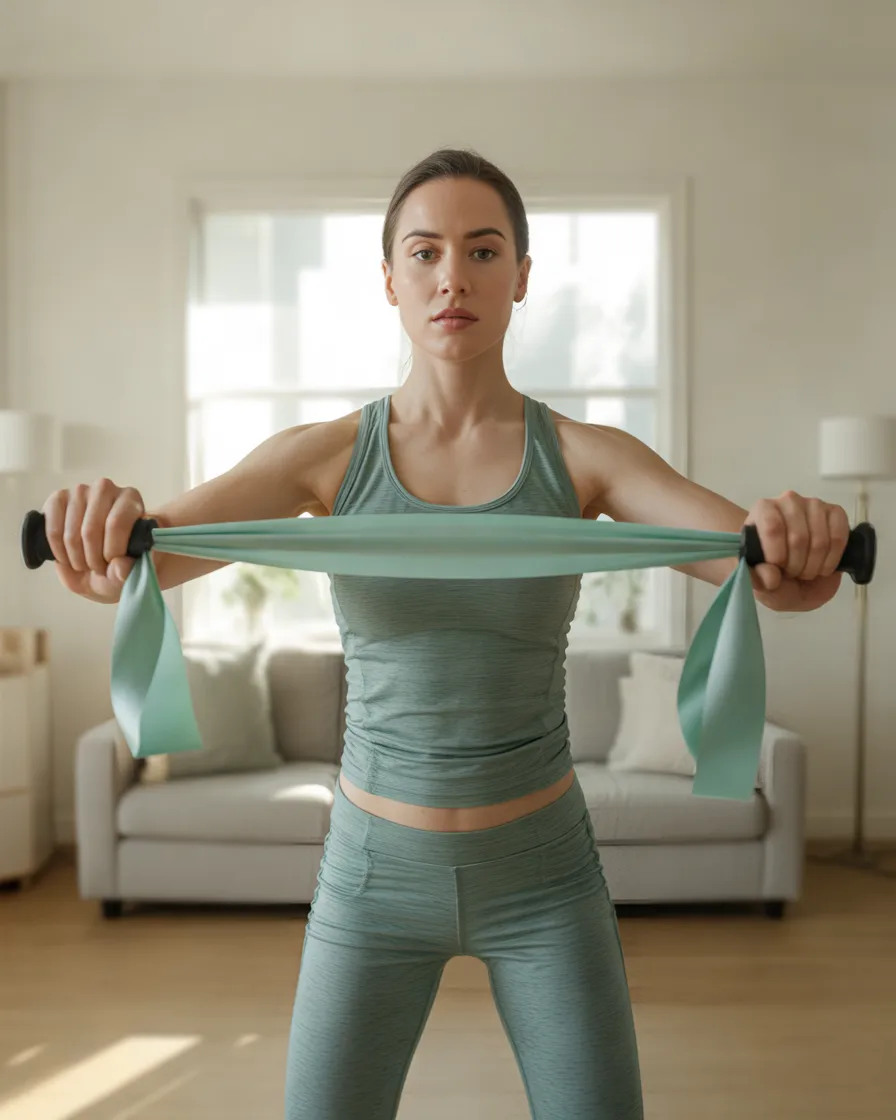
Most of these exercises use bodyweight resistance. However, you can eventually introduce resistance bands or a backpack containing a few books to increase the challenge.
Warm up before exercising
Spend approximately 5–10 minutes preparing your muscles and joints. A simple warm-up can include:
- Marching in place for one minute.
- Gentle bodyweight squats.
- Alternating knee lifts.
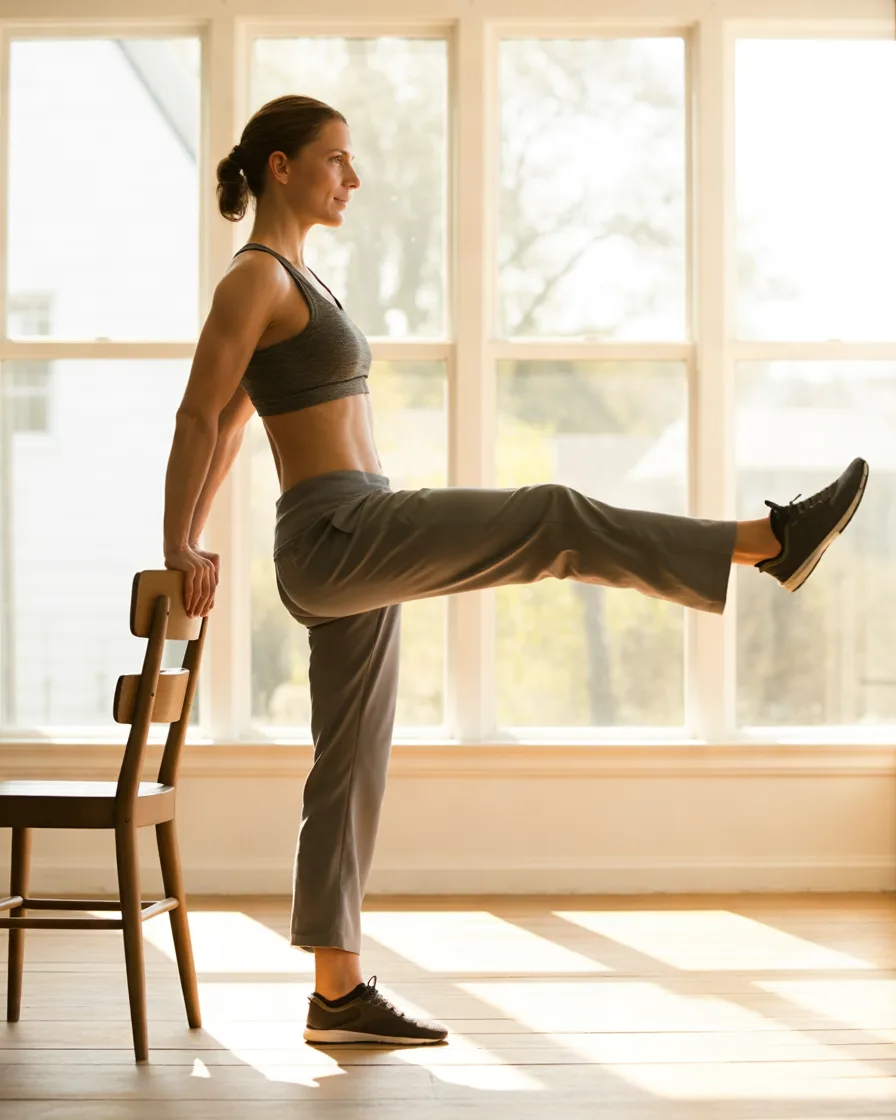
- Leg swings while holding a stable surface.
- Slow walking around your workout area.
A warm-up helps prepare your body for more demanding movements. Mayo Clinic also recommends warming up before strength training and using controlled movements rather than rushing through repetitions.
1. Bodyweight Squats: A Foundation for Building Lower-Body Strength
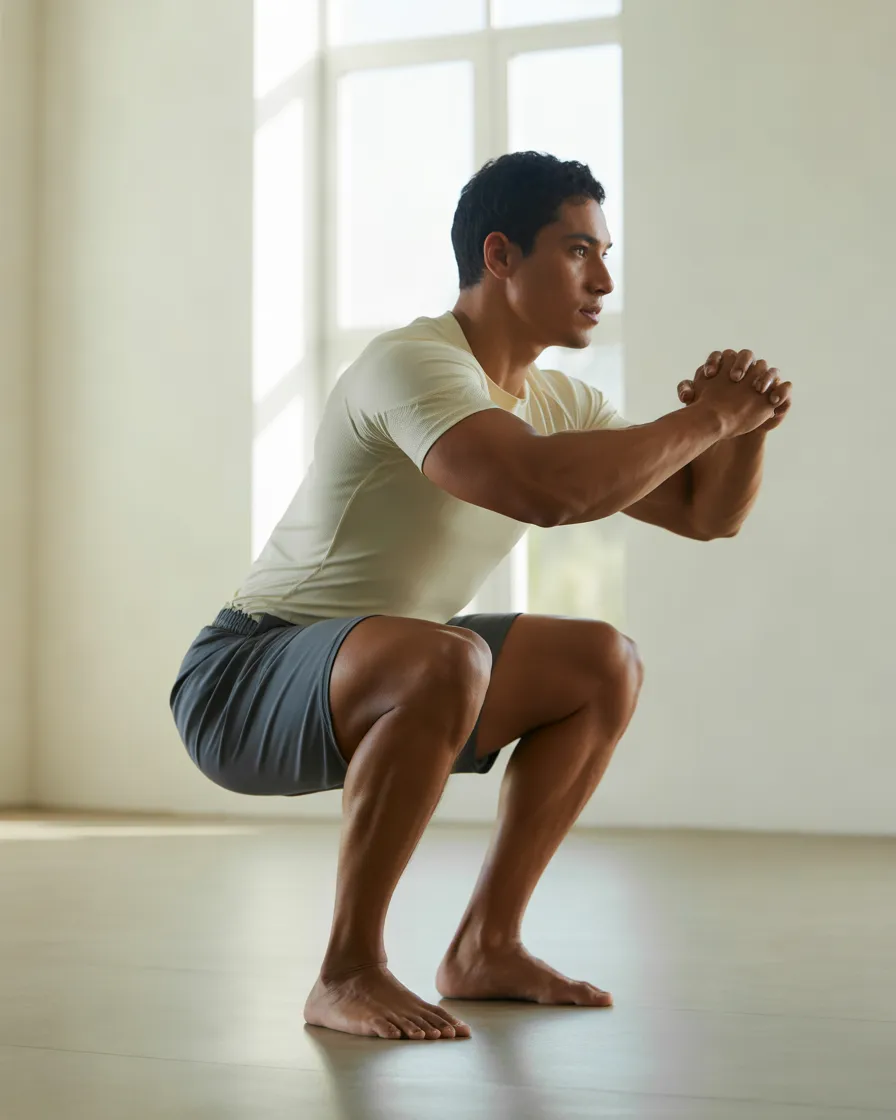
Bodyweight squats are one of the most practical exercises for a leg day workout at home. They target the quadriceps, glutes, and other muscles that help control your hips and knees. You can perform them without equipment, making them suitable for beginners and experienced exercisers.
The movement also resembles everyday activities such as sitting down, standing up, and picking something up from a low surface.
Benefits:
- Strengthens the quadriceps and glute muscles.
- Develops lower-body muscular endurance.
- Helps improve control during sitting and standing movements.
- Provides a foundation for more challenging squat variations.
- Requires no special equipment.
How to perform bodyweight squats:
- Stand with your feet approximately shoulder-width apart.
- Point your toes slightly outward if that feels natural.
- Keep your chest comfortably lifted and your abdomen engaged.
- Push your hips backward as you bend your knees.
- Lower yourself as far as you can while maintaining control.
- Press through your feet to return to the starting position.
Recommended routine: Perform 2–3 sets of 10–12 repetitions, resting for approximately 60–90 seconds between sets.
Practical tips: Imagine sitting back into an invisible chair. Keep your feet firmly on the floor and allow your knees to move in the same general direction as your toes. If maintaining balance is difficult, practice sitting down onto a sturdy chair and standing back up.
Who it may suit: Beginners, people returning to exercise, and anyone looking for a simple lower-body strength exercise.
Important considerations: Do not force yourself into a deep squat. Start with a comfortable range of motion and gradually improve it. Stop if you experience sharp or unusual joint pain.
2. Reverse Lunges: Improve Leg Strength and Single-Leg Stability
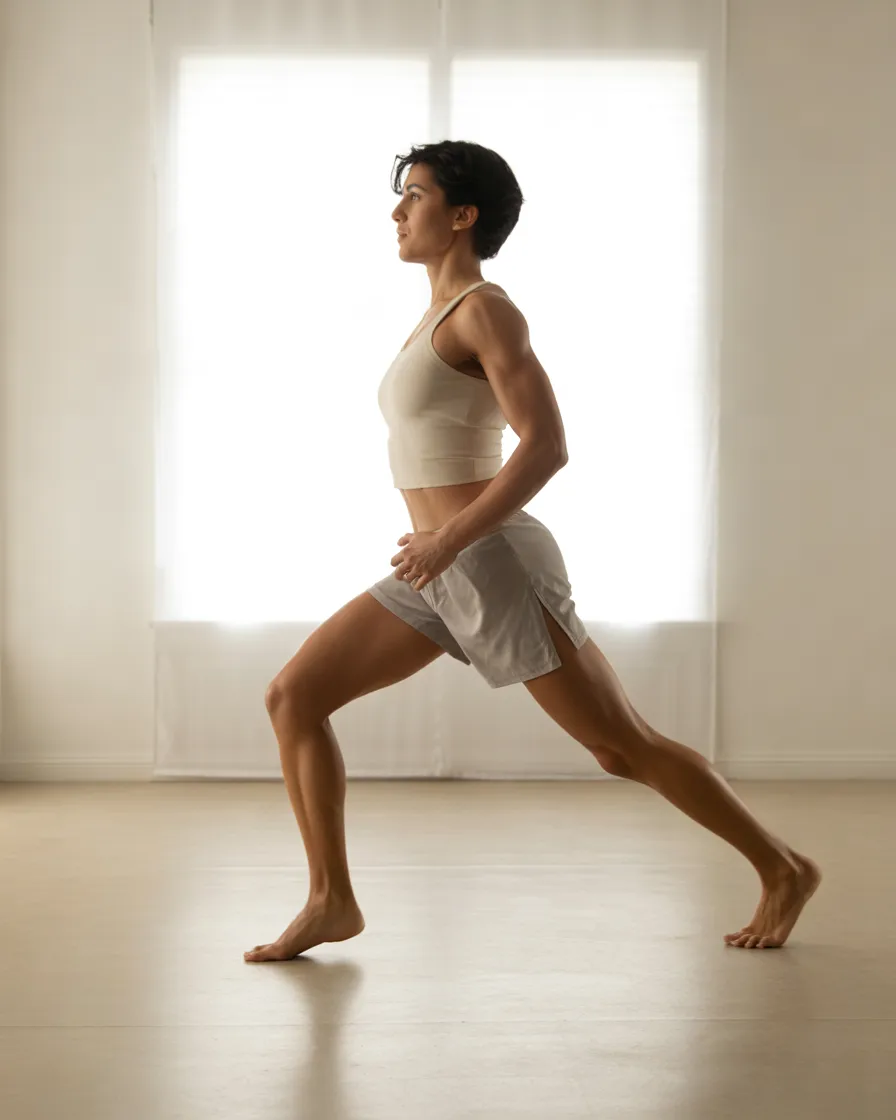
Reverse lunges are an excellent addition to a home leg workout because they train one leg at a time. Unlike traditional squats, this movement challenges your ability to maintain balance while controlling your body through a stepping motion.
The exercise primarily works the quadriceps and glutes while also involving the hamstrings and stabilizing muscles around the hips.
Benefits:
- Develops strength in each leg independently.
- Challenges balance and coordination.
- Strengthens the quadriceps and glutes.
- Helps identify differences in strength between the two sides.
- Requires very little space.
How to perform reverse lunges:
- Stand upright with your feet approximately hip-width apart.
- Take a controlled step backward with your right foot.
- Bend both knees while lowering your body.
- Keep your front foot flat on the floor.
- Lower until you reach a comfortable position.
- Push through your front foot to return to standing.
- Repeat with the opposite leg.
Recommended routine: Complete 2–3 sets of 8–10 repetitions per leg.
Practical tips: Start with smaller backward steps if you struggle with balance. Keep your torso relatively upright and avoid rushing between repetitions. You can hold a wall or sturdy chair for additional support.
Who it may suit: Beginners who can perform basic squats comfortably, intermediate exercisers, and people wanting to improve single-leg strength.
Important considerations: Make sure the floor is not slippery. If your front knee feels uncomfortable, reduce the depth of the movement or use a supported variation.
3. Static Split Squats: Build Stronger Quadriceps and Glutes
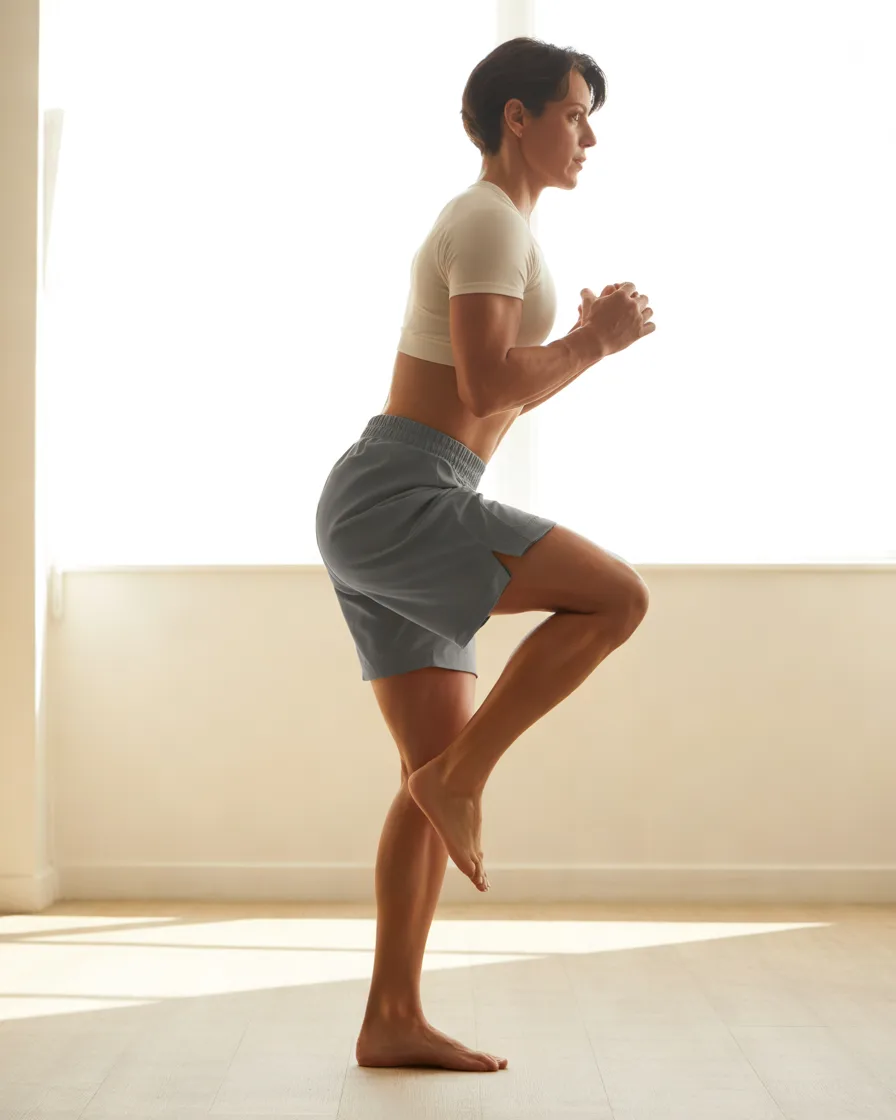
Static split squats are similar to lunges, but your feet remain in the same position throughout the exercise. This makes the movement easier to control because you do not need to step backward and forward repeatedly.
It is particularly useful for people who want to strengthen their legs while practicing balance and movement control.
Benefits:
- Targets the quadriceps and glutes.
- Develops single-leg strength.
- Challenges balance and stability.
- Allows you to work on each side separately.
- Provides a useful progression from basic squats.
How to perform static split squats:
- Stand with one foot forward and the other foot behind you.
- Keep enough distance between your feet to maintain balance.
- Distribute your weight comfortably between both legs.
- Bend your knees and lower your hips toward the floor.
- Keep your front foot flat and your torso controlled.
- Push through your front foot to return to the starting position.
- Complete your repetitions before changing legs.
Recommended routine: Perform 2 sets of 8–10 repetitions per leg.
Practical tips: Beginners can hold the back of a sturdy chair or stand near a wall. Avoid placing your feet directly in one straight line, as a slightly wider stance usually provides better balance.
Who it may suit: People who have mastered basic squats and want to develop more challenging lower-body strength.
Important considerations: Start with a shallow movement. Your front knee should remain aligned with your foot rather than collapsing inward. If balance is difficult, use hand support.
4. Glute Bridges: Strengthen Your Glutes and Posterior Chain
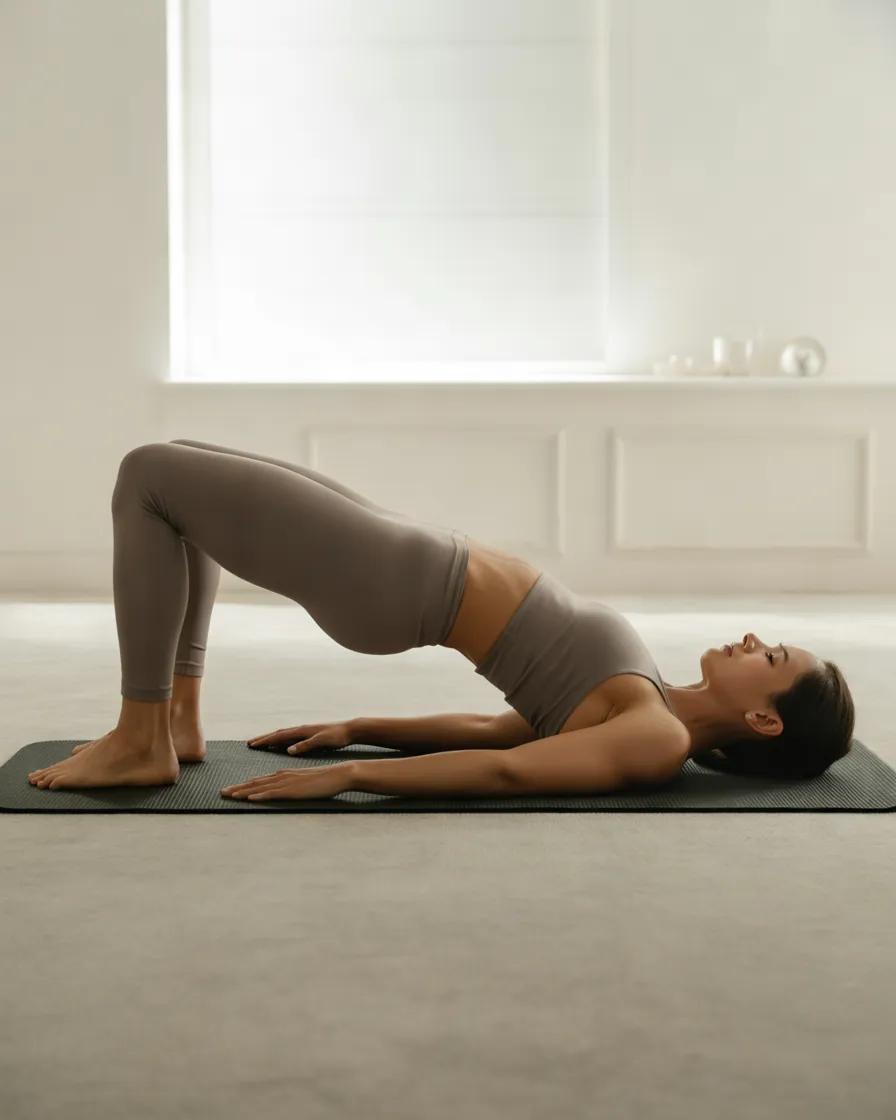
Glute bridges are performed while lying on your back, making them a useful alternative to standing leg exercises. They primarily target the gluteal muscles and also involve the hamstrings.
They are particularly valuable in a balanced lower-body routine because many common leg exercises emphasize knee movement, while glute bridges focus more directly on hip extension.
Benefits:
- Strengthens the glute muscles.
- Engages the hamstrings.
- Develops hip-extension strength.
- Provides a low-impact alternative to jumping exercises.
- Can be performed in a small space.
How to perform glute bridges:
- Lie on your back on an exercise mat.
- Bend your knees and place both feet flat on the floor.
- Keep your feet approximately hip-width apart.
- Position your arms beside your body.
- Tighten your abdominal muscles gently.
- Press through your feet and lift your hips.
- Stop when your shoulders, hips, and knees form an approximately straight line.
- Squeeze your glutes briefly before lowering slowly.
Recommended routine: Complete 2–3 sets of 12–15 repetitions.
Practical tips: Focus on lifting through your hips rather than arching your lower back. Keep your feet positioned so that you can comfortably press through them.
Who it may suit: Beginners, people who prefer floor-based exercises, and anyone wanting to strengthen their glutes without using weights.
Important considerations: Avoid pushing your hips excessively high. If you experience lower-back discomfort, reduce the lifting height and reassess your positioning.
5. Single-Leg Glute Bridges: Challenge Your Glutes One Side at a Time
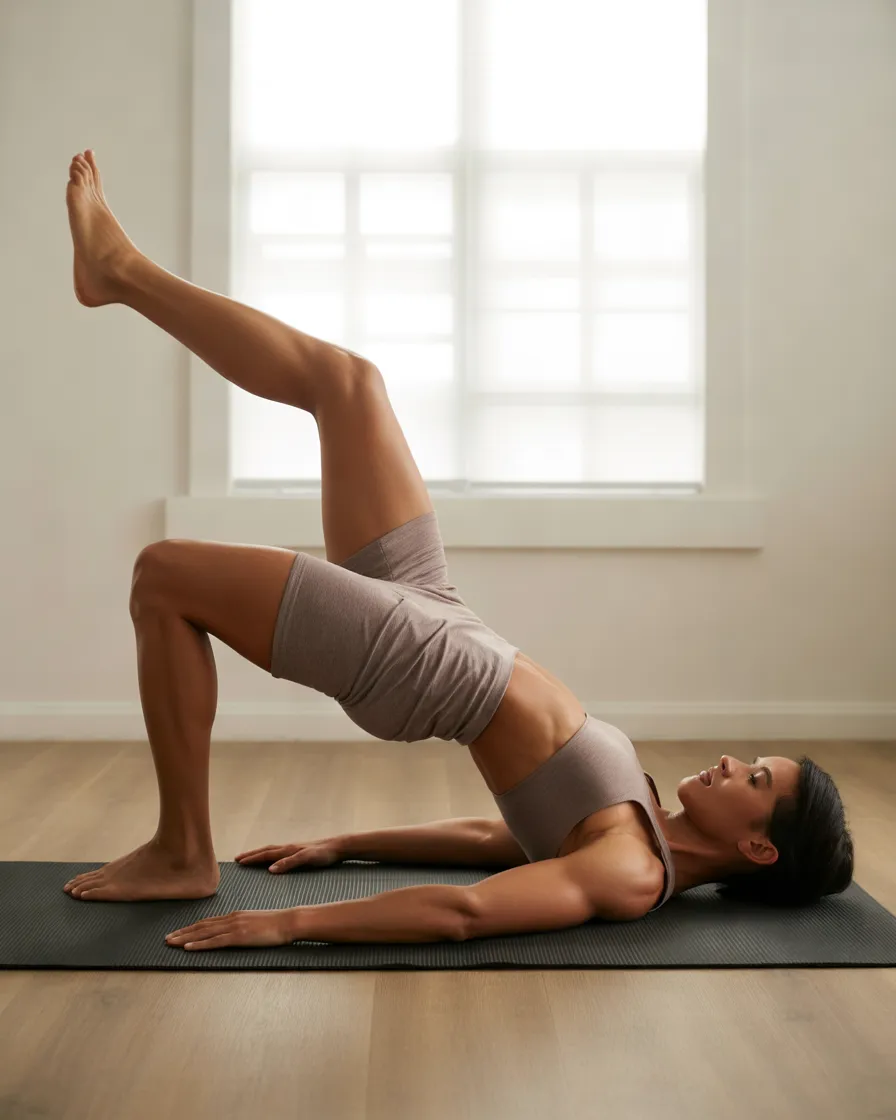
Once regular glute bridges become comfortable, single-leg glute bridges offer a more demanding variation.
This exercise requires you to support your hips using one leg while keeping the other leg lifted. As a result, it challenges the working glute, hamstrings, and muscles responsible for controlling pelvic position.
It is also a useful way to assess whether one side feels noticeably less coordinated or strong than the other.
Benefits:
- Increases the challenge of a traditional glute bridge.
- Develops single-leg hip-extension strength.
- Engages the hamstrings and glutes.
- Challenges pelvic stability.
- Requires no additional equipment.
How to perform single-leg glute bridges:
- Lie on your back with both knees bent.
- Place your feet flat on the floor.
- Lift one foot slightly off the floor.
- Keep the lifted leg in a comfortable position.
- Press through the supporting foot.
- Raise your hips without allowing them to rotate.
- Lower slowly and repeat.
- Switch legs after completing your repetitions.
Recommended routine: Perform 2 sets of 8–10 repetitions per side.
Practical tips: Keep your hips level throughout the movement. If your pelvis rotates or your lower back arches, return to the regular two-leg variation until you develop better control.
Who it may suit: Intermediate exercisers and people who can perform standard glute bridges with good technique.
Important considerations: This variation can feel significantly harder than a regular bridge. You do not need to lift your hips as high if doing so compromises your form.
6. Step-Ups: Train Your Legs With a Simple Elevated Platform
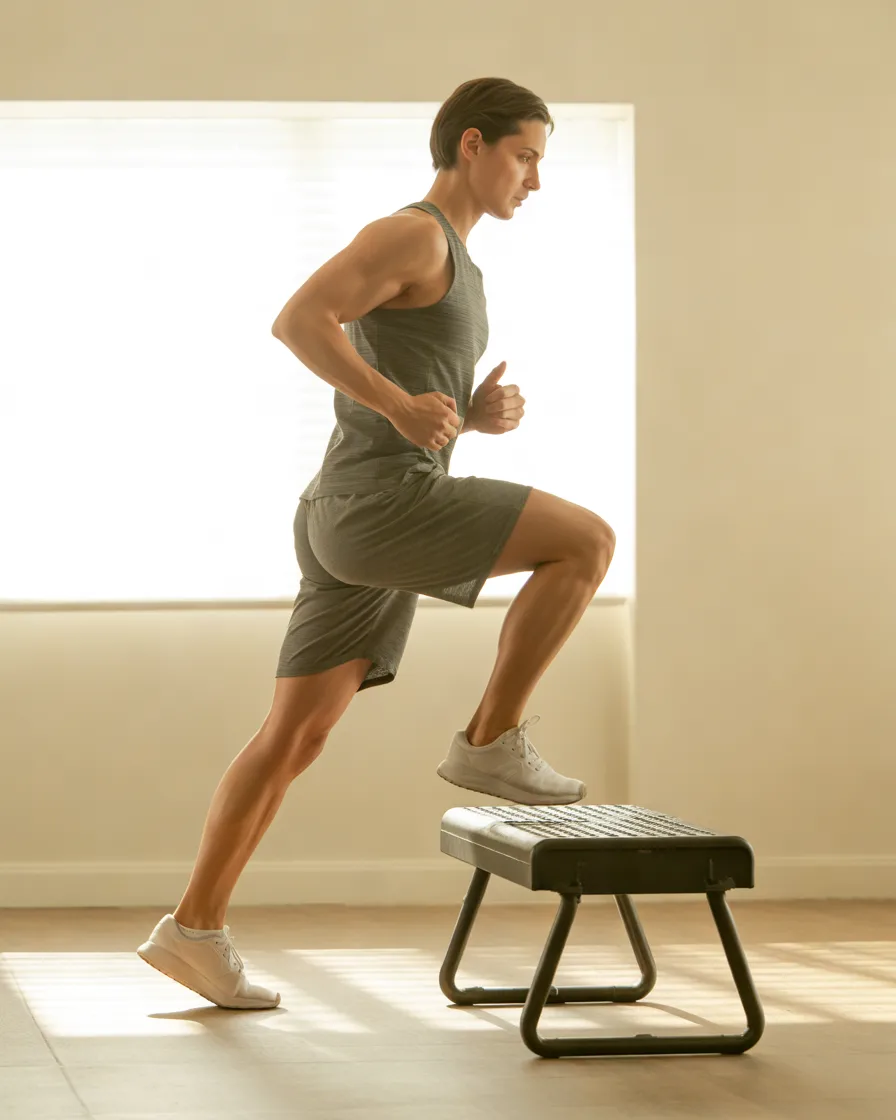
Step-ups are functional lower-body exercises that involve stepping onto an elevated surface and returning to the floor.
They engage the quadriceps and glutes while challenging balance and coordination. The movement also resembles everyday activities such as climbing stairs.
You only need a low, sturdy platform or exercise step to perform this exercise at home.
Benefits:
- Strengthens the quadriceps and glutes.
- Develops single-leg movement control.
- Challenges balance and coordination.
- Helps practice stair-climbing movements.
- Can be adjusted by changing the platform height.
How to perform step-ups:
- Stand facing a low, stable exercise platform.
- Place your entire right foot on the platform.
- Press through that foot to bring your body upward.
- Bring your other foot onto the platform.
- Step down carefully and return to your starting position.
- Repeat using the opposite leading leg.
Recommended routine: Complete 2 sets of 8–10 repetitions per leg.
Practical tips: Choose a platform low enough that you can step up without twisting your hips or forcing your knee into an uncomfortable position. Perform each repetition slowly rather than jumping onto the platform.
Who it may suit: Beginners and intermediate exercisers who want a practical exercise for developing lower-body strength.
Important considerations: Platform stability is essential. Never use a rolling chair, unstable furniture, or a slippery surface. If you have balance difficulties, use an appropriate hand support or choose another exercise.
7. Standing Calf Raises: Develop Stronger Calf Muscles
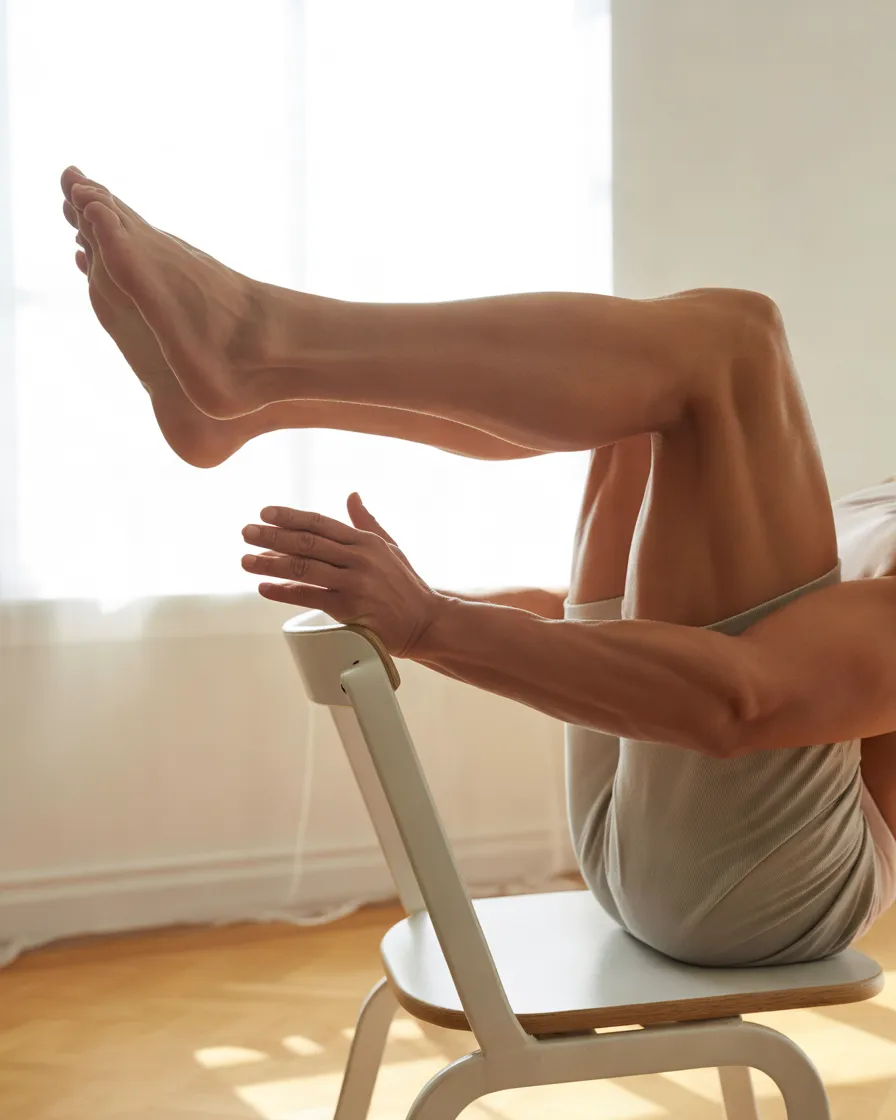
Calf raises are often overlooked during leg training, even though the calf muscles contribute to walking, running, standing, and pushing the body forward.
This exercise focuses on the gastrocnemius and soleus muscles, which make up much of the lower-leg muscle group.
The movement is simple, but performing it slowly and through a comfortable range can make it challenging without additional weights.
Benefits:
- Strengthens the calf muscles.
- Develops lower-leg muscular endurance.
- Supports the muscles involved in ankle movement.
- Can be performed almost anywhere.
- Offers an easy exercise for beginners.
How to perform standing calf raises:
- Stand upright with your feet approximately hip-width apart.
- Place your hands on a wall or sturdy chair for balance.
- Keep your knees comfortably straight but not forcefully locked.
- Slowly lift your heels off the floor.
- Rise onto the balls of your feet.
- Pause briefly at the top.
- Lower your heels slowly to the starting position.
Recommended routine: Perform 2–3 sets of 15–20 repetitions.
Practical tips: Avoid bouncing at the bottom or using momentum to lift your body. Try pausing for one second at the top of each repetition. As your balance improves, you can gradually reduce hand support.
Who it may suit: Beginners, experienced exercisers, and people looking to include more complete lower-leg training in their routine.
Important considerations: If you have existing Achilles tendon or ankle problems, seek professional advice before increasing the intensity. Stop if you experience pain.
8. Wall Sits: Improve Quadriceps Muscular Endurance
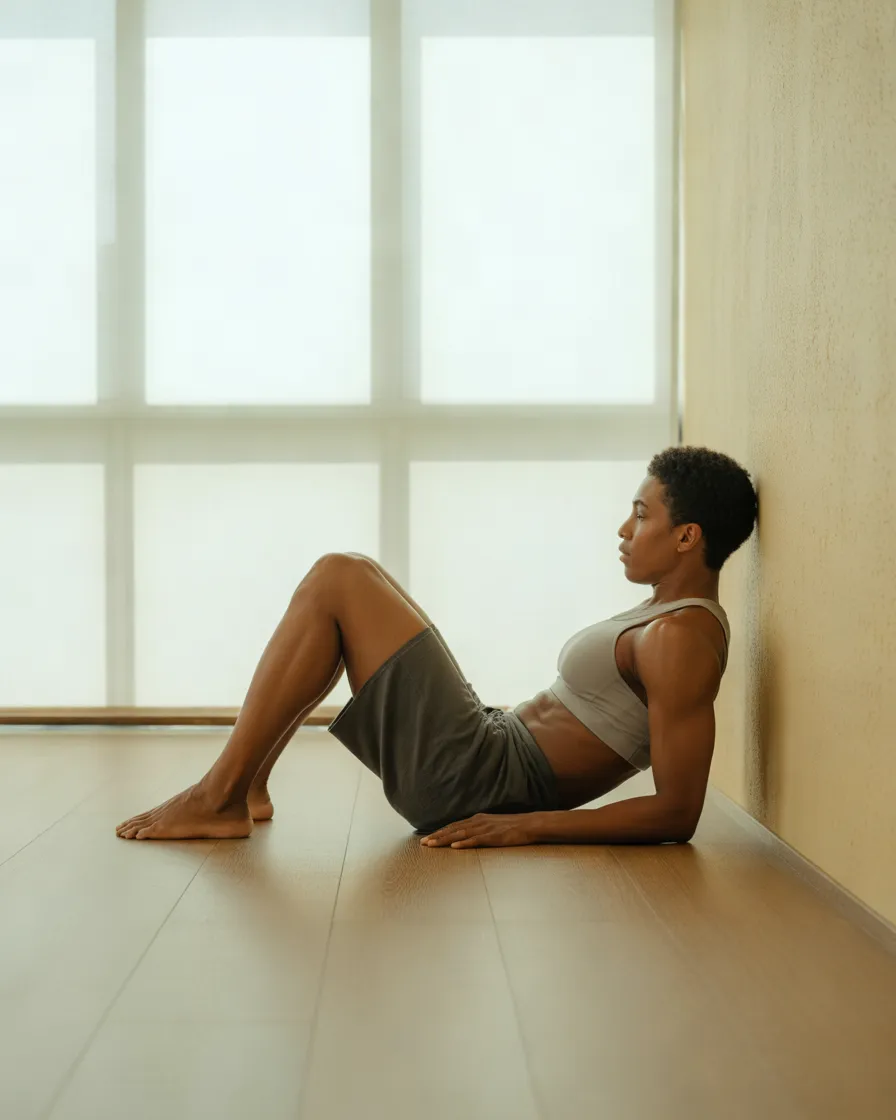
Wall sits are a simple isometric exercise. Unlike squats, where you repeatedly move up and down, you hold a seated position against a wall for a specific amount of time.
The quadriceps do much of the work, while the glutes and other lower-body muscles help maintain the position.
This makes wall sits a useful addition to a leg day workout at home, particularly when you want to train muscular endurance without performing repeated movements.
Benefits:
- Challenges quadriceps endurance.
- Engages the glute muscles.
- Develops the ability to maintain a controlled position.
- Requires no equipment.
- Offers a different training stimulus from regular squats.
How to perform wall sits:
- Stand with your back against a clear, sturdy wall.
- Move your feet slightly forward.
- Slowly slide your back down the wall.
- Stop when your knees reach a comfortable bent position.
- Keep your feet flat on the floor.
- Maintain the position while breathing normally.
- Slowly slide upward to finish.
Recommended routine: Hold for 20–40 seconds and repeat for 2–3 sets.
Practical tips: Beginners can start with a shallower position and hold it for 10–15 seconds. Gradually increase the duration as your endurance improves.
Who it may suit: People who want to improve quadriceps endurance and prefer exercises without repeated stepping or lifting movements.
Important considerations: Do not force your knees into a deep bend. Keep your feet positioned comfortably and stop if you experience knee pain, dizziness, or unusual discomfort.
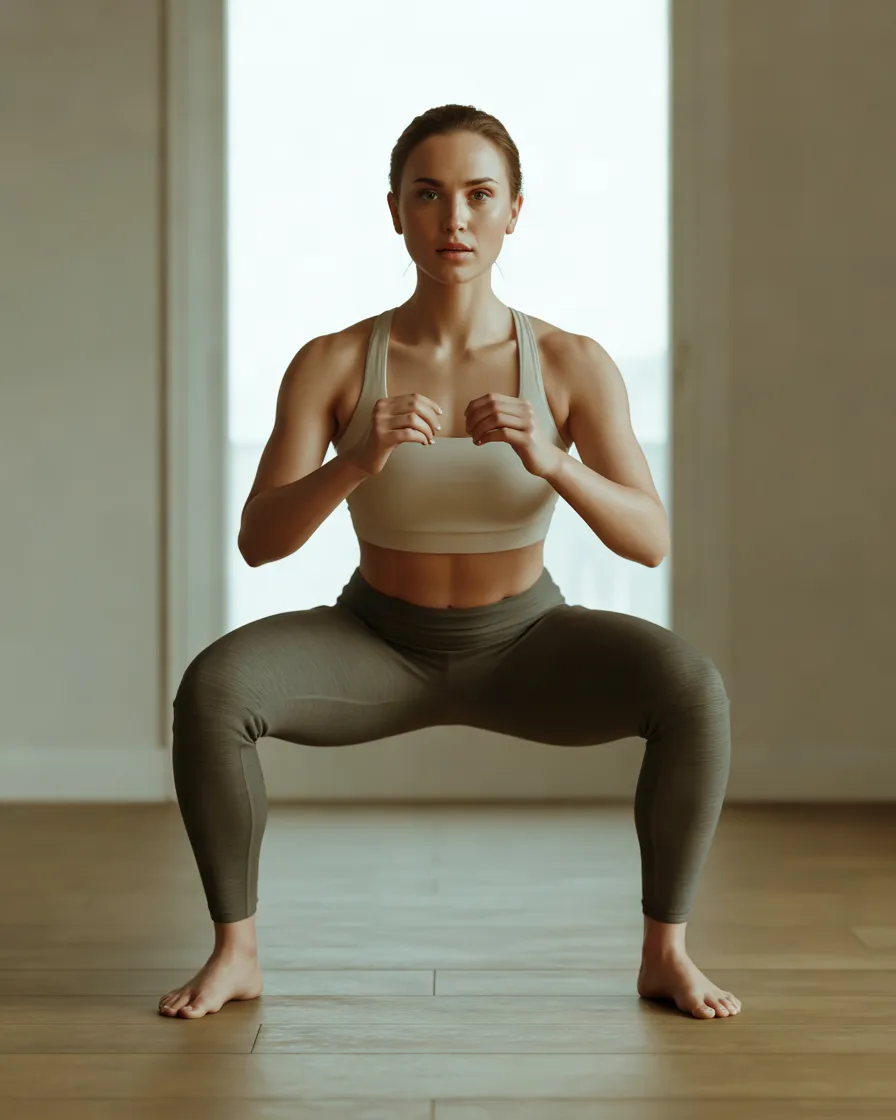
9. Sumo Squats: Target Your Inner Thighs and Glutes
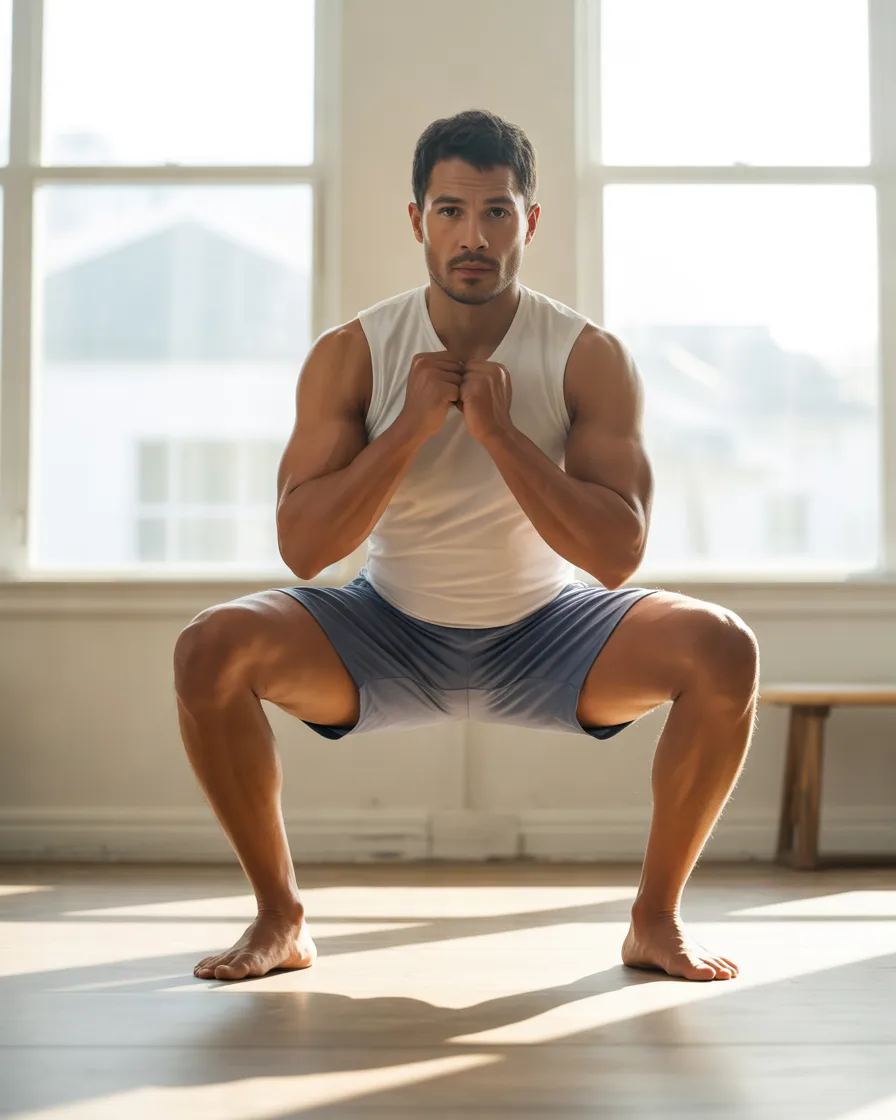
Sumo squats are a wider-stance variation of traditional squats. They involve a slightly different hip position and can provide more emphasis on the muscles responsible for controlling the hips and inner thighs.
The quadriceps and glutes remain important working muscles, while the adductor muscles of the inner thighs help control the movement.
Benefits:
- Strengthens the quadriceps and glutes.
- Engages the inner-thigh muscles.
- Develops hip movement control.
- Adds variety to a bodyweight leg workout.
- Can be performed without gym equipment.
How to perform sumo squats:
- Stand with your feet wider than shoulder-width apart.
- Turn your toes slightly outward.
- Keep your chest comfortably lifted.
- Push your hips backward as you bend your knees.
- Lower your body while keeping your feet grounded.
- Keep your knees tracking in the direction of your toes.
- Press through your feet to return to standing.
Recommended routine: Perform 2–3 sets of 10–12 repetitions.
Practical tips: Find a stance that allows you to squat comfortably without forcing your hips or knees. Keep the movement controlled and avoid leaning excessively forward.
Who it may suit: Beginners who are comfortable with basic squats and intermediate exercisers looking for more lower-body variety.
Important considerations: A wider stance is not automatically better. Adjust your foot position according to your individual hip mobility and comfort.
10. Lateral Lunges: Strengthen Your Legs With Side-to-Side Movement
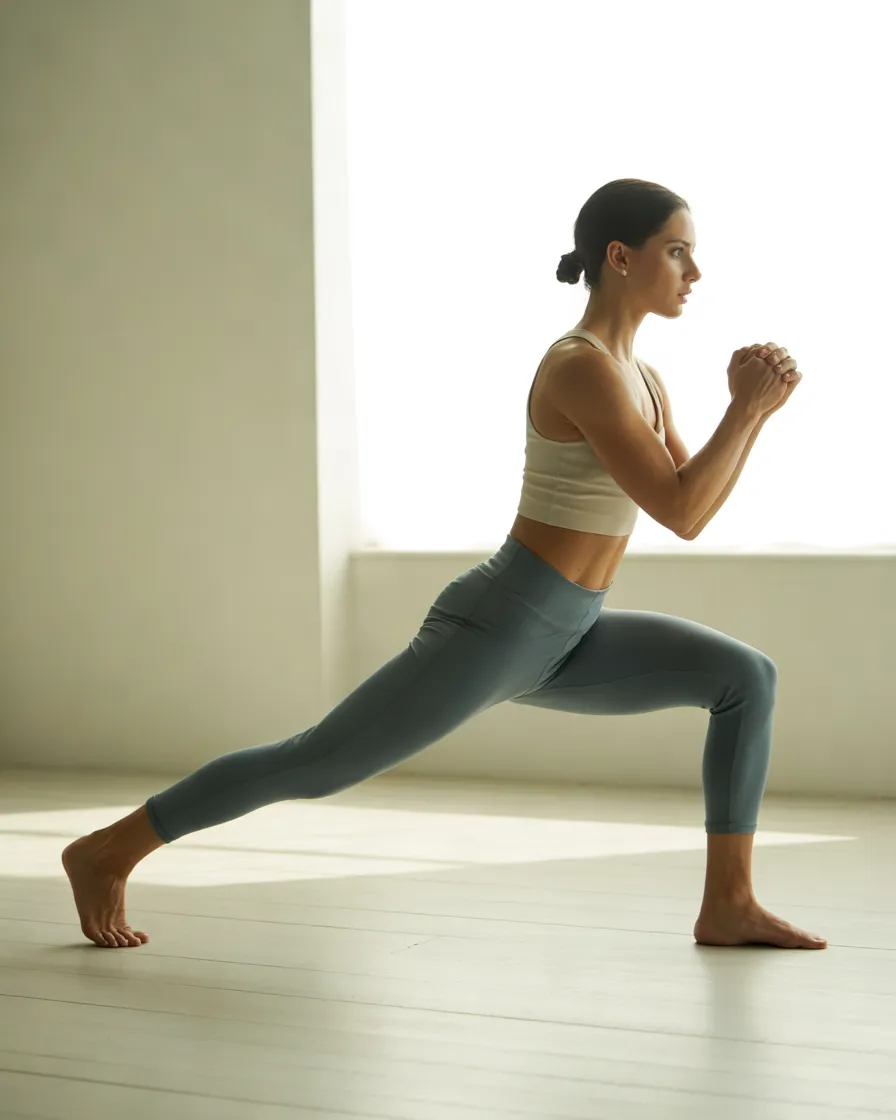
Most traditional leg exercises involve forward and backward movement. Lateral lunges introduce a different direction by asking you to move sideways.
This exercise targets the quadriceps, glutes, and inner-thigh muscles while challenging hip control and movement coordination.
It can help make your lower-body training more varied because it introduces movement in the frontal plane rather than relying entirely on forward-facing exercises.
Benefits:
- Strengthens the quadriceps and glutes.
- Engages the inner-thigh muscles.
- Challenges side-to-side movement control.
- Develops hip and leg coordination.
- Adds variety to a home leg routine.
How to perform lateral lunges:
- Stand upright with your feet together or slightly apart.
- Take a controlled step to your right.
- Bend your right knee while pushing your hips backward.
- Keep your left leg relatively straight.
- Lower your body only as far as comfortable.
- Push through your right foot to return to the starting position.
- Repeat on the opposite side.
Recommended routine: Perform 2 sets of 8–10 repetitions per side.
Practical tips: Start with a relatively small sideways step. Focus on controlling your hips and keeping your working foot flat on the floor. Avoid rushing between sides.
Who it may suit: People who already feel comfortable with basic squats and want to develop more varied lower-body movement.
Important considerations: This exercise requires some hip and ankle mobility. Do not force a deep position if your body feels restricted. A smaller range of motion is perfectly acceptable when learning the movement.
11. Bodyweight Good Mornings: Strengthen Your Hamstrings and Hip Hinge
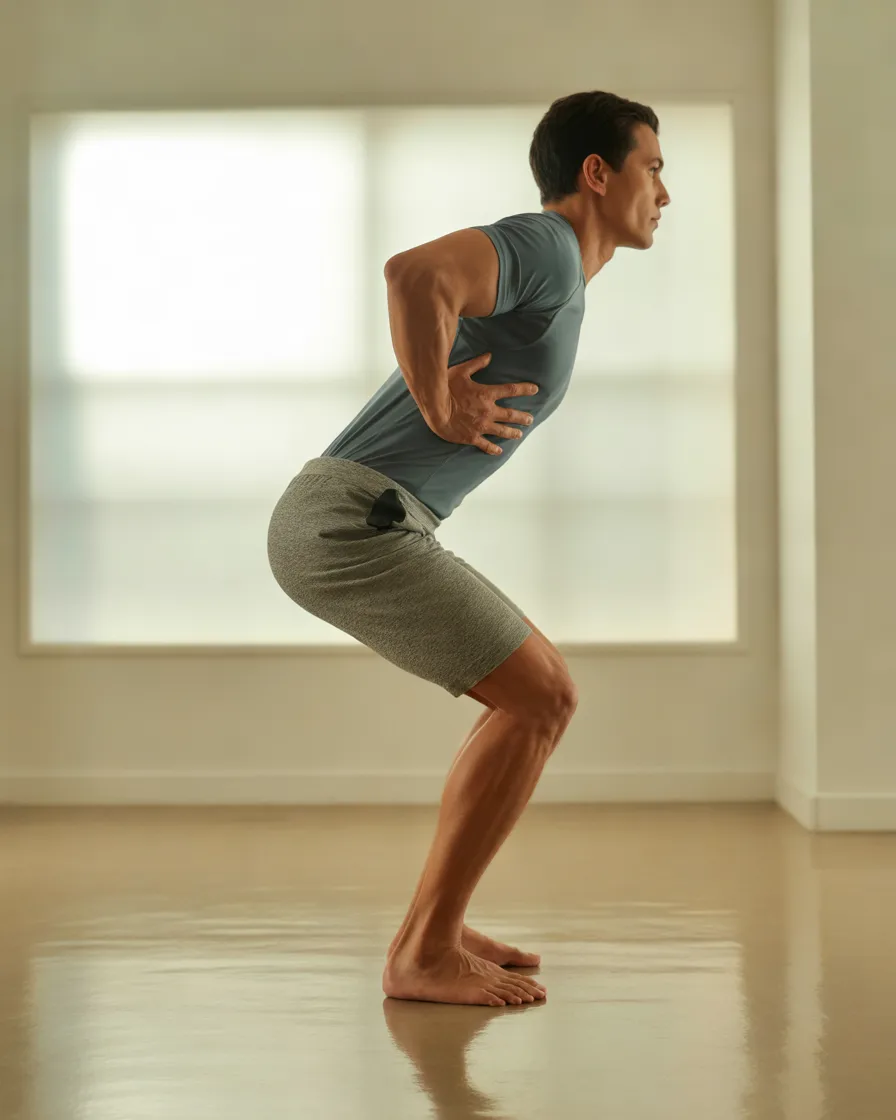
Good mornings are a useful bodyweight exercise for people who want to train the posterior chain, particularly the hamstrings, glutes, and muscles that help maintain trunk position.
The movement focuses on hinging at the hips rather than bending deeply at the knees.
Learning this pattern is valuable because hip hinging is involved in everyday tasks such as picking up shopping bags or lifting objects from the floor.
Benefits:
- Strengthens the hamstrings and glutes.
- Develops hip-hinge coordination.
- Encourages controlled movement through the hips.
- Adds posterior-chain training to a squat-focused routine.
- Can prepare beginners for more advanced hinge exercises.
How to perform bodyweight good mornings:
- Stand upright with your feet approximately hip-width apart.
- Place your hands across your chest or behind your head.
- Keep a slight bend in your knees.
- Engage your abdominal muscles gently.
- Push your hips backward while leaning your torso forward.
- Keep your spine in a comfortable neutral position.
- Stop when you feel a gentle stretch in your hamstrings.
- Push your hips forward to return to standing.
Recommended routine: Perform 2–3 sets of 10–12 repetitions.
Practical tips: Think about closing a car door with your hips. Your hips should move backward while your torso naturally leans forward. Keep the movement controlled instead of trying to reach the floor.
Who it may suit: Beginners learning hip-hinge mechanics and intermediate exercisers wanting additional hamstring and glute work.
Important considerations: Avoid rounding your lower back or forcing a deeper position. If you have an existing back condition or experience pain, consult an appropriate healthcare or exercise professional before attempting this movement.
12. Hamstring Walkouts: Challenge the Back of Your Legs Without Equipment
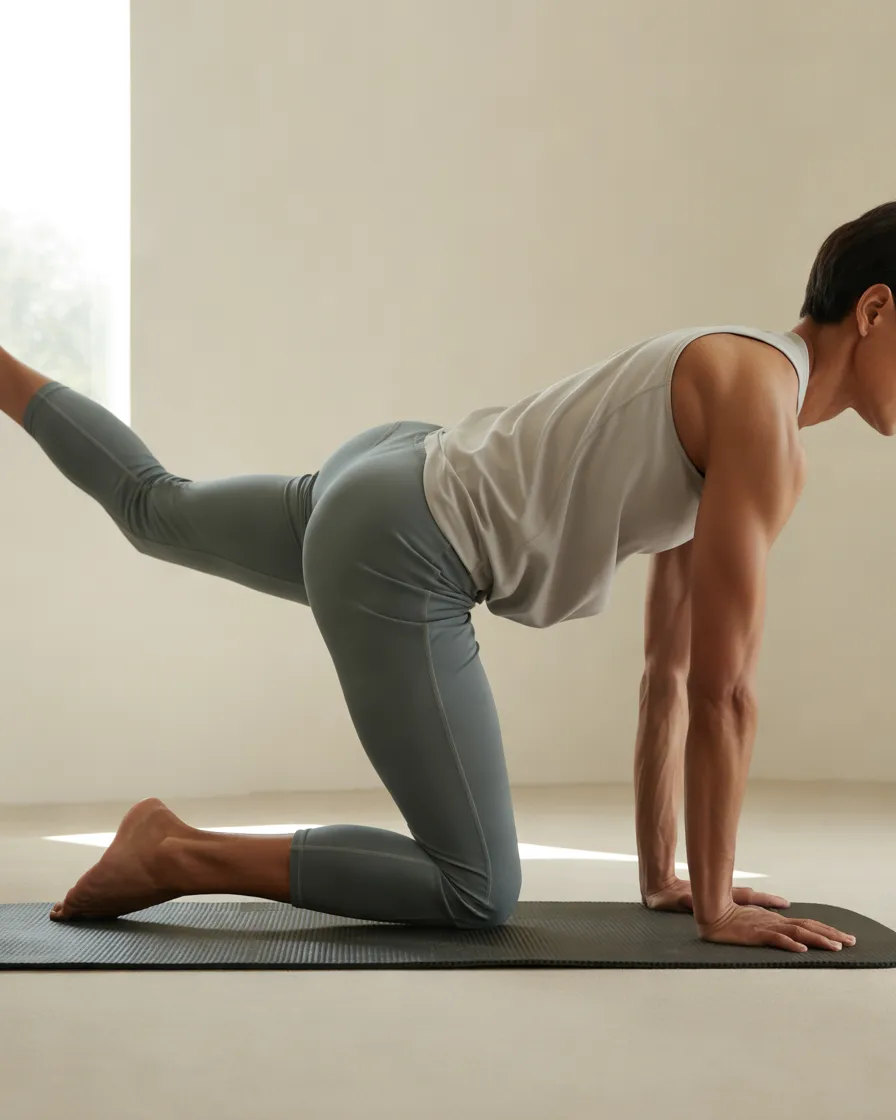
Hamstring walkouts are a challenging floor-based exercise that targets the hamstrings and glutes.
They begin in a glute bridge position, but instead of holding your hips still, you gradually walk your heels away from your body and then bring them back.
This increases the demand on your hamstrings and requires controlled movement throughout the exercise.
Benefits:
- Strengthens the hamstrings.
- Engages the glutes.
- Develops posterior-chain muscular endurance.
- Challenges hip control.
- Requires only a small amount of floor space.
How to perform hamstring walkouts:
- Lie on your back with your knees bent.
- Place your feet flat on the floor.
- Lift your hips into a glute bridge position.
- Slowly move one heel forward a short distance.
- Follow with the opposite heel.
- Continue taking small steps until your legs are more extended.
- Walk your heels back toward your body.
- Lower your hips once you finish the repetition.
Recommended routine: Complete 2 sets of 6–8 controlled walkouts.
Practical tips: Take small steps instead of immediately extending your legs completely. Keep your hips lifted as much as you comfortably can. If your hips drop or your hamstrings cramp, shorten the movement.
Who it may suit: Intermediate exercisers who can comfortably perform regular glute bridges.
Important considerations: This movement can be demanding, especially for people who are new to hamstring training. Start with a short walking distance and avoid pushing through cramps or pain.
How to Combine These 12 Exercises Into an Effective Leg Day Workout at Home
Knowing individual exercises is useful, but the way you combine them matters just as much.
You do not need to perform all 12 exercises in one session. Doing too many movements, particularly when starting out, can create unnecessary fatigue and make it harder to maintain good technique.
Instead, select exercises that train different parts of your lower body.
Beginner leg day workout
| Exercise | Sets | Repetitions |
|---|---|---|
| Bodyweight squats | 2 | 10 |
| Reverse lunges | 2 | 8 per leg |
| Glute bridges | 2 | 12 |
| Standing calf raises | 2 | 15 |
| Wall sits | 2 | 15–20 seconds |
Start with this routine if you are relatively new to resistance training. Use a chair or wall for support when necessary.
Intermediate leg day workout
| Exercise | Sets | Repetitions |
|---|---|---|
| Bodyweight squats | 3 | 12 |
| Static split squats | 2 | 10 per leg |
| Sumo squats | 2 | 12 |
| Single-leg glute bridges | 2 | 10 per leg |
| Bodyweight good mornings | 3 | 12 |
| Hamstring walkouts | 2 | 6–8 |
| Standing calf raises | 3 | 15–20 |
Rest for approximately 60–90 seconds between sets, adjusting your recovery time according to the difficulty of the exercises.
These routines are starting points, not fixed requirements. Reduce the number of sets if you cannot maintain proper technique.
Expert Tips to Get More From Your Home Leg Workout
A successful leg workout is not simply about completing a large number of repetitions. Exercise selection, consistency, recovery, and gradual progression all influence how effectively you train.
Here are practical ways to make your routine more effective.
1. Prioritize proper exercise technique
Performing 10 controlled squats is generally more useful than rushing through 25 repetitions with poor positioning.
Pay attention to your foot placement, knee alignment, hip movement, and breathing. Use a mirror or record a short video to check your technique if necessary.
2. Increase difficulty gradually
Your muscles adapt to repeated training. Once an exercise becomes relatively easy, consider increasing the challenge.
You can do this by:
- Adding two or three repetitions.
- Performing an additional set.
- Slowing down the lowering phase.
- Introducing a brief pause during the exercise.
- Using a resistance band or appropriately loaded backpack.
Make one adjustment at a time so you can evaluate how your body responds.
3. Give your muscles enough recovery time
Muscles need time to recover after demanding resistance training.
For most beginners, two lower-body strength sessions per week on nonconsecutive days provide a reasonable starting point. Allow at least one full day between challenging sessions for the same muscle groups.
Recovery also involves adequate sleep, hydration, and balanced nutrition.
4. Do not ignore your hamstrings and calves
Many people focus heavily on squats and lunges because they are familiar exercises.
However, a balanced routine should include movements that challenge the muscles at the back of the legs and the lower legs.
Glute bridges, good mornings, hamstring walkouts, and calf raises help provide this variety.
5. Use controlled movements instead of momentum
Avoid bouncing, swinging, or rushing through repetitions.
For example, when performing a squat, take a controlled amount of time to lower yourself and then return to standing smoothly.
This makes it easier to maintain your position and focus on the intended muscles.
6. Combine strength training with regular physical activity
A leg workout is one part of a complete fitness routine.
Adults are generally advised to accumulate at least 150 minutes of moderate-intensity aerobic activity each week and perform muscle-strengthening activities on at least two days. Walking, cycling, and swimming can complement your home strength sessions.
These recommendations are outlined by the CDC’s adult physical activity guidelines.
7. Adjust your routine to your current fitness level
You do not need to copy an advanced athlete’s workout.
If you are starting from scratch, use supported squats, regular glute bridges, and assisted reverse lunges. As your strength and coordination improve, introduce more demanding variations.
Consistency is more valuable than attempting an unnecessarily difficult workout once and then struggling to continue.
Frequently Asked Questions About Leg Day Workout at Home
1. Can I build stronger legs with a leg day workout at home without weights?
Yes. Bodyweight exercises can provide meaningful resistance for developing lower-body strength, particularly when you are new to strength training.
Squats, lunges, glute bridges, step-ups, and split squats can all challenge your leg muscles. As you become stronger, you may need to increase repetitions, slow the movement, choose harder variations, or introduce external resistance to continue progressing.
2. How many times a week should I train my legs at home?
For most beginners, two leg-strength sessions per week on nonconsecutive days are a reasonable starting point.
More experienced exercisers may train their lower body more frequently, depending on training intensity, exercise selection, and recovery.
The important thing is to allow sufficient recovery between demanding sessions rather than training the same muscles intensely every day.
3. How long should a home leg day workout take?
A practical home leg workout can take approximately 25–40 minutes, including a warm-up, exercise sets, and rest periods.
Beginners may need less time because they can start with fewer exercises and sets. Intermediate exercisers may require longer sessions depending on their training plan.
Quality of movement matters more than completing a workout within an arbitrary time limit.
4. What is the best leg exercise for beginners at home?
Bodyweight squats are an excellent starting point because they train multiple lower-body muscles and require no equipment.
Glute bridges and supported calf raises are also useful beginner-friendly options.
If you struggle with balance, try chair-assisted squats or supported reverse lunges before moving to more challenging variations.
5. Can home leg workouts help improve muscle definition?
Regular resistance training can help develop the muscles of your thighs, calves, and glutes.
Visible muscle definition depends on several factors, including muscle development, genetics, nutrition, and overall body composition.
Combining consistent strength training with appropriate nutrition and regular physical activity can support your fitness goals, but individual results vary.
6. Do leg day workouts at home help burn belly fat?
Leg exercises use energy and involve large muscle groups, but they do not specifically remove fat from your stomach.
Fat loss depends on overall energy balance, physical activity, nutrition, sleep, and other individual factors.
A balanced approach that combines strength training, aerobic exercise, and sustainable eating habits is more useful than relying on one exercise to target a particular body area.
7. Should I exercise my legs if they are sore after a workout?
Mild muscle soreness can occur after unfamiliar or demanding exercise. If the discomfort is mild, gentle walking or light movement may be comfortable.
However, significant soreness, reduced movement, or pain that affects your normal activities is a reason to postpone demanding leg training.
Sharp pain, swelling, or persistent symptoms should not be treated as ordinary workout soreness. Seek appropriate medical advice when needed.
8. Can I do a leg day workout at home every day?
Daily intense leg training is generally unnecessary, particularly for beginners.
Your muscles need recovery time to adapt to resistance training. Instead of performing demanding leg exercises every day, alternate strength sessions with walking, mobility work, or upper-body training.
9. What should I eat after a leg workout?
A balanced meal containing protein and carbohydrates can support recovery after exercise.
Examples include:
- Eggs with whole-grain toast.
- Greek yogurt with fruit.
- Chicken with rice and vegetables.
- Lentils with whole-grain roti.
- Milk with a banana and a balanced meal later.
Your overall daily nutrition matters more than consuming a particular food immediately after finishing your workout.
10. Do I need gym equipment for an effective home leg workout?
No. You can begin with bodyweight exercises and gradually increase their difficulty.
A resistance band, a pair of dumbbells, or a securely loaded backpack can provide additional resistance later. However, none of these is essential when you are learning basic movement patterns.
Safety Considerations Before Starting Your Leg Training Routine
Although bodyweight exercises are accessible, they still place demands on your muscles and joints.
Keep these precautions in mind:
- Start with a manageable number of exercises and repetitions.
- Warm up before demanding movements.
- Use stable furniture and platforms when support is required.
- Avoid slippery floors and loose workout surfaces.
- Maintain comfortable ranges of motion.
- Stop exercising if you experience sharp pain, dizziness, or unusual symptoms.
- Increase exercise difficulty gradually.
If you have a chronic health condition, a history of significant joint or back problems, a recent injury or surgery, or specific exercise restrictions, consult a qualified healthcare professional before beginning a new training routine.
The NHS strength exercise guidance also emphasizes starting gradually and using stable support when needed.
Conclusion: Make Your Leg Day Workout at Home a Consistent Habit
You do not need a gym membership to develop a practical and effective lower-body training routine. A carefully selected combination of squats, lunges, glute bridges, calf raises, hip hinges, and hamstring exercises can help you train your legs in the comfort of your home.
Start with the exercises that match your current fitness level. Focus on proper technique, allow enough recovery time, and gradually increase the difficulty as your strength improves.
Most importantly, remember that progress comes from consistency rather than attempting the hardest workout on your first day. Choose a realistic routine, make it part of your weekly schedule, and give yourself enough time to improve.